


FINEO is vacuum insulated glass made by AGC Glass Europe in Belgium: two panes sealed around a vacuum, 7.7 mm thick in all, with a U-value of 0.7. That is close to triple glazing at a quarter of its thickness, which is why it fits the rebate of an old timber sash where regular double glazing won’t.
We are sash window restorers, not the maker or its distributor. We have fitted vacuum glass into original windows since the days of Pilkington’s Spacia, the first of its kind, and now fit FINEO and LandVac, the two sold in the UK. This guide is what we tell homeowners who ask about it: what it is, what it costs, how it compares, what you notice once it is in, and what fitting it into an old sash involves.
What is FINEO glass?
Two panes of glass are sealed together along their edges, and the air between them is pumped out. The gap is a fraction of a millimetre, held open by a grid of tiny pillars, because without them the air outside would press the panes together. A vacuum carries almost no heat, so the glass insulates like a much thicker unit.
FINEO is made by AGC Glass Europe, one of the world’s largest glass makers, at its plant in Lodelinsart near Charleroi. It carries a CE mark under European Technical Assessment ETA 20/0048, and AGC makes the glass it is built from. It has no evacuation port, the small sealed hole near one corner where the air is drawn out, so from the room it reads as a single clear pane. There is no inert gas in it to leak away, and it is fully recyclable.
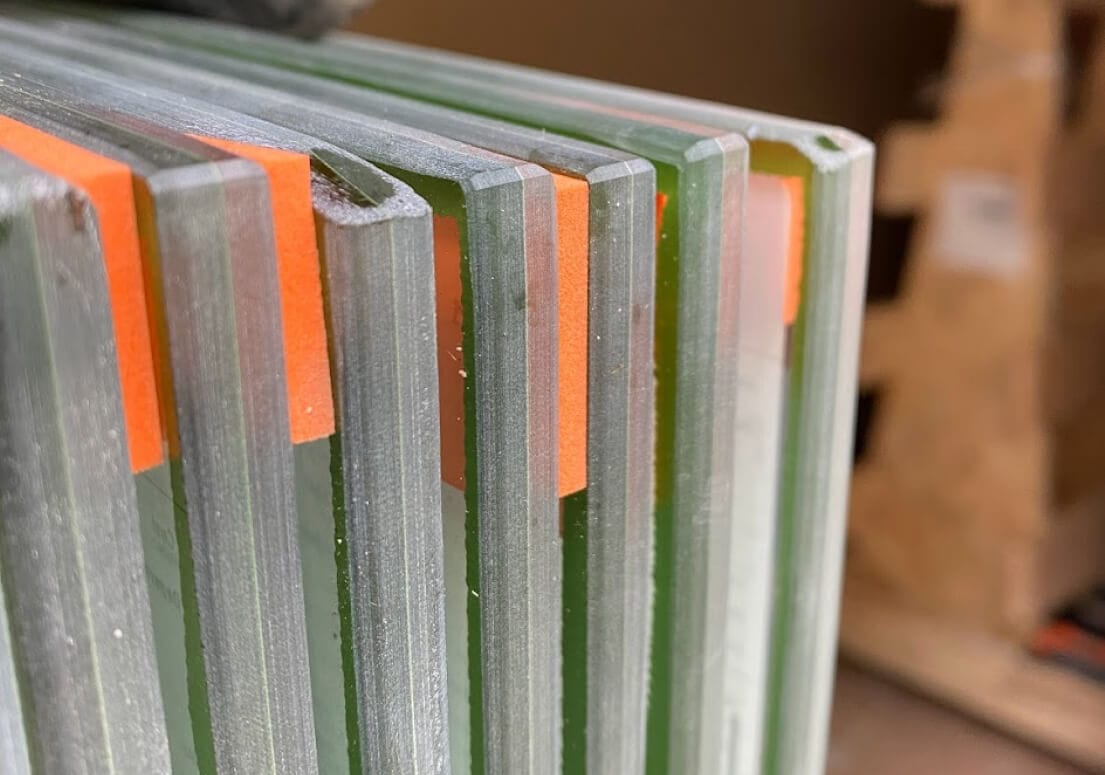
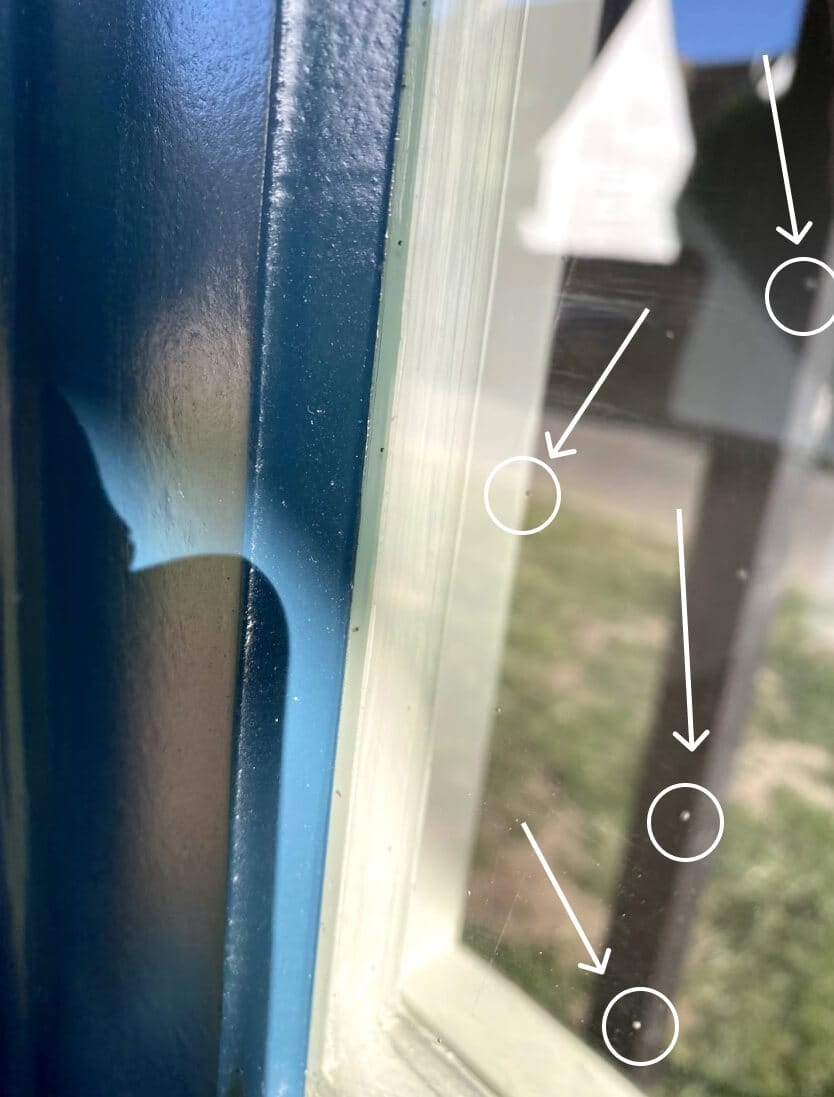
FINEO units as they arrived for one of our jobs, and the support pillars on a pane we fitted. You see the pillars close up, not from across the room.
The FINEO range and its specifications
FINEO comes in four thicknesses. Each insulates the same; the thicker ones are stronger and quieter. Most sash and casement windows take FINEO 8.
| Thickness | U-value (W/m²K) | Daylight through | Sound (Rw) | Used for | |
|---|---|---|---|---|---|
| FINEO 6 | 6.7 mm | 0.7 | 80% | – | The slimmest rebates |
| FINEO 8 | 7.7 mm | 0.7 | 79% | 35 dB | Most sash and casement windows |
| FINEO 10 | 9.7 mm | 0.7 | 79% | 36 dB | Toughened: doors and low panes |
| FINEO 12 | 11.7 mm | 0.7 | 78% | 36 dB | Larger panes |
Panes run from 0.2 × 0.2 m up to 1.5 × 2.5 m, or 1.6 × 2.4 m. The glass can be laminated for safety, or made with patterned or old-style glass on the outside. It weighs about 20 kg a square metre, twice as much as the 4 mm single glass it usually replaces, and two-thirds as much as triple glazing.
How much does FINEO glass cost?
Two different prices get quoted for FINEO, and mixing them up is why figures online seem to disagree: the glass on its own, and the glass fitted into your windows.
The glass on its own
FINEO is sold by the unit when it is small and by the square metre when it is larger, plus delivery, an energy surcharge that changes monthly, and VAT. A small order pays the most per square metre, because one delivery costs the same for one window as for ten.
| Small units | Larger units | From the factory | |
|---|---|---|---|
| FINEO 8 (7.7 mm) | about £120 each, under 0.35 m² | about £340 per m² | 4–5 weeks |
| FINEO 10 toughened (9.7 mm) | about £200 each, under 0.5 m² | about £390 per m² | 6–8 weeks |
| Order size | Delivery |
|---|---|
| Up to 10 m² | about £550 |
| 10–20 m² | about £450 |
| 20–50 m² | about £300 |
| 50 m² or more | free |
Fitted into your sash windows
Most of the cost of reglazing an old window is the work, not the glass: taking the old glass out, deepening the rebates, repairing the sash so it can carry the extra weight, heavier weights and new cords, then glazing, sealing and painting.
We fit vacuum glass only as part of a full restoration, because a sash with rot in it can’t carry glass twice as heavy. With the restoration, rot repairs, new cords and weights and draught-proofing included, it costs from £1,050 a window, typically £1,050–£1,550 for an average-size sash, or £10,500–£15,500 for a house with ten. The minimum order is five windows. We don’t sell the glass on its own: if you have a joiner lined up, FINEO’s UK distributor sells through its installers.
Get your estimate
No form and no visit needed: send us photos of your house and we email you an estimate, usually within 15% of the final price.
What to send
- A photo of each side of the house with sash windows, taken far enough back that every window is in it
- Your full address, with the postcode
- How many windows you have
or send them to
We reply within one working day and send your estimate within three. Minimum order: 5 windows.

“Extremely happy with the end result.” James, Suffolk
How warm is FINEO?
With 20°C inside and 0°C outside, a square metre of single glass lets out about 116 watts; FINEO lets out about 14. That is roughly an eighth as much, and the inside pane stays close to room temperature instead of cold to the touch.
| Thickness | U-value | Daylight through | Sound (Rw) | |
|---|---|---|---|---|
| Single glass | 4 mm | 5.8 | 90% | 29 dB |
| Slim gas-filled double glazing | 11 mm | 1.9 | 80% | 31 dB |
| Standard double glazing | 28 mm | 1.2 | 80% | 31 dB |
| Triple glazing (argon) | 36–44 mm | 0.5–0.6 | 71% | 32 dB |
| FINEO 8 | 7.7 mm | 0.7 | 79% | 35 dB |
Triple glazing is a little warmer, but it needs 36–44 mm of glass and gas, and no old sash has room for that. All these figures are for the glass at the centre of the pane. A whole window’s figure also depends on its frame and on the edge of the glass, where the two panes are sealed together.
Our own test
We built a box with five glazing samples side by side, single glass, triple glazing, slim double glazing, regular double glazing and FINEO, heated it from inside and looked at it through a thermal camera. The single glass glowed white, the slim and regular double glazing glowed yellow and red, and the triple glazing and FINEO stayed dark.
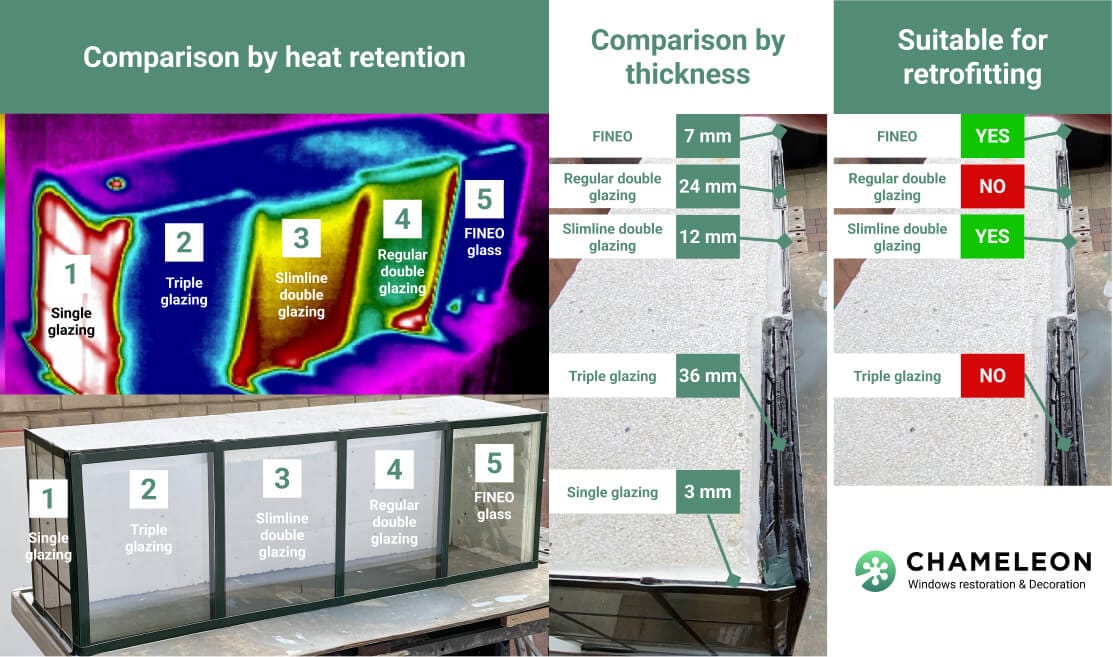
From our jobs
On a cold morning, the windows we reglazed with vacuum glass show up dark on the thermal camera, beside single-glazed neighbours that glow. The edges stay a little brighter than the middle: that is the seal, and it is why makers quote the U-value at the centre of the pane.
Does FINEO reduce noise?
Yes, more than most people expect from glass this thin. FINEO 8 has a sound reduction index of 35 dB, against 29 dB for single glass and 31–32 dB for double and triple glazing. Six decibels is about a third less noise to the ear. Noise also gets in through the gaps around the sashes, so the draught-proofing that comes with every reglazing helps too.
FINEO or LandVac?
FINEO and LandVac are the two vacuum glasses most UK installers use, and we fit both. They are about the same thickness and both fit an original sash. Where they differ:
| FINEO 8 | LandVac | |
|---|---|---|
| Made by | AGC Glass Europe, Belgium | LandVac, China |
| Thickness | 7.7 mm | 8.3 mm |
| U-value (W/m²K) | 0.7 | 0.48 |
| Safety glass | Plain; toughened or laminated to order | Always toughened |
| Pane sizes | 0.2 × 0.2 m to 1.5 × 2.5 m | 0.3 × 0.3 m to 1.5 × 2.5 m |
| Maker’s warranty | 20 years | Ask us: it depends on the unit |
- LandVac keeps a little more heat in and is always toughened, which suits doors and the low panes where building regulations ask for safety glass.
- FINEO is made in Europe, has no evacuation port and carries a 20-year maker’s warranty. Plain FINEO 8 can also go into smaller panes than LandVac’s minimum.
- Either way, single glass lets out eight to twelve times the heat. We tell you which suits your windows when we see them.
What you notice once FINEO is fitted
- It looks like single glass. No thick spacer bar around the edge and no corner port; slim original glazing bars stay slim.
- A faint grid of dots when you look closely: the support pillars. From across the room you don’t see them.
- Dew on the outside some mornings. The outer pane now stays as cold as the air, so on damp autumn and spring mornings dew forms outside and clears as the sun comes up. It means the heat is staying in.
- Far less condensation inside, because the inside pane stays warm, so the timber under it stays drier.
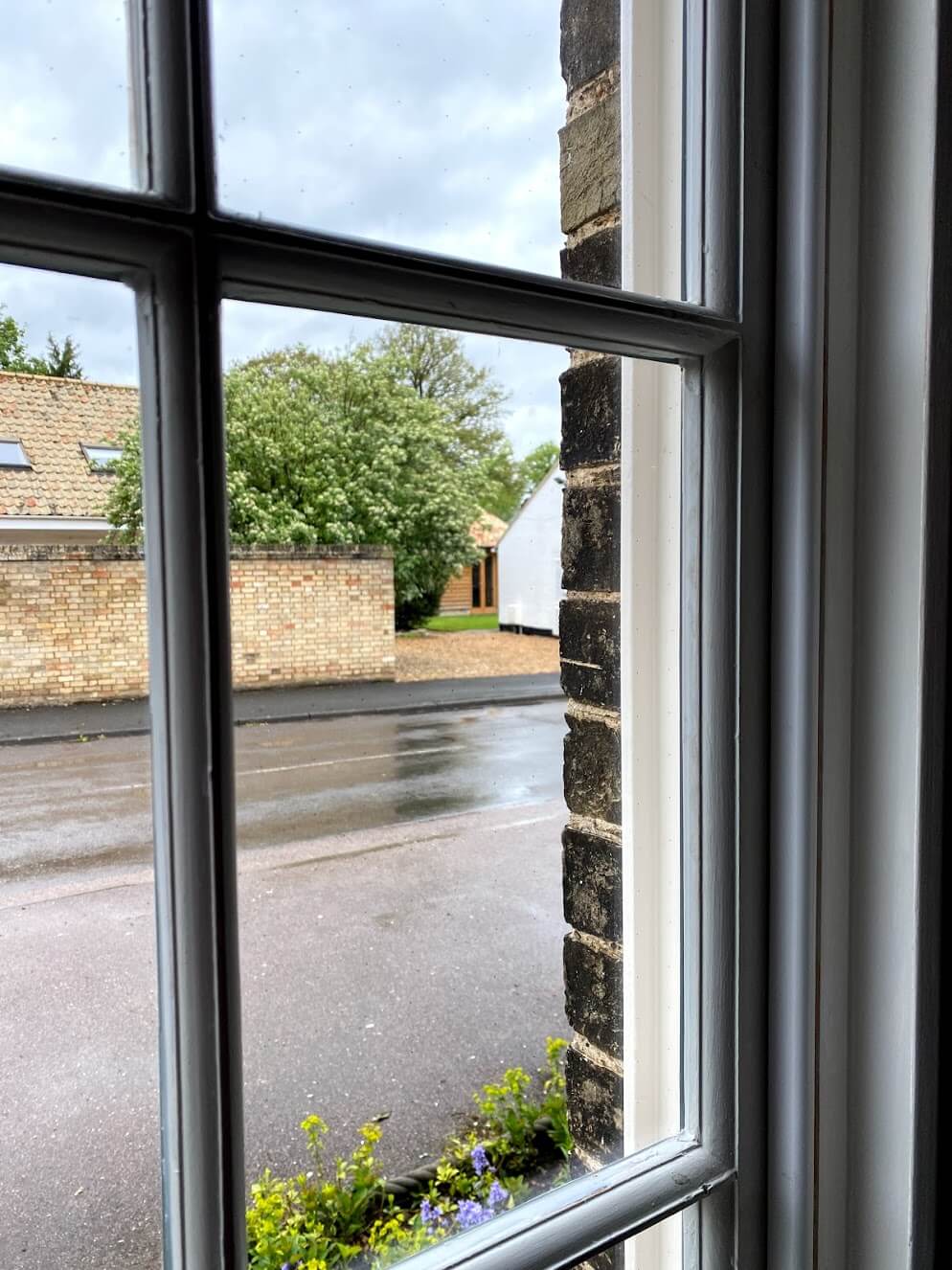
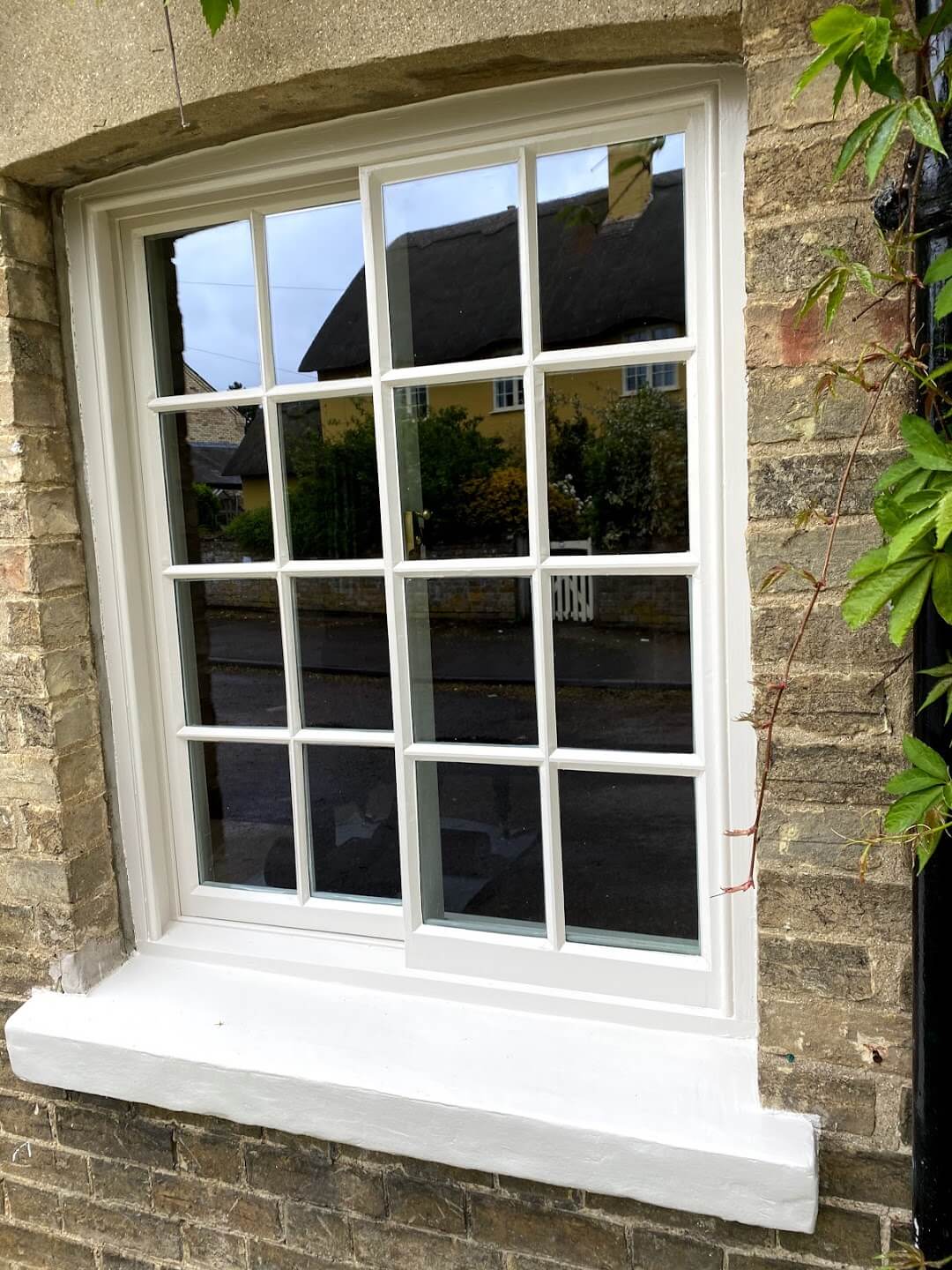
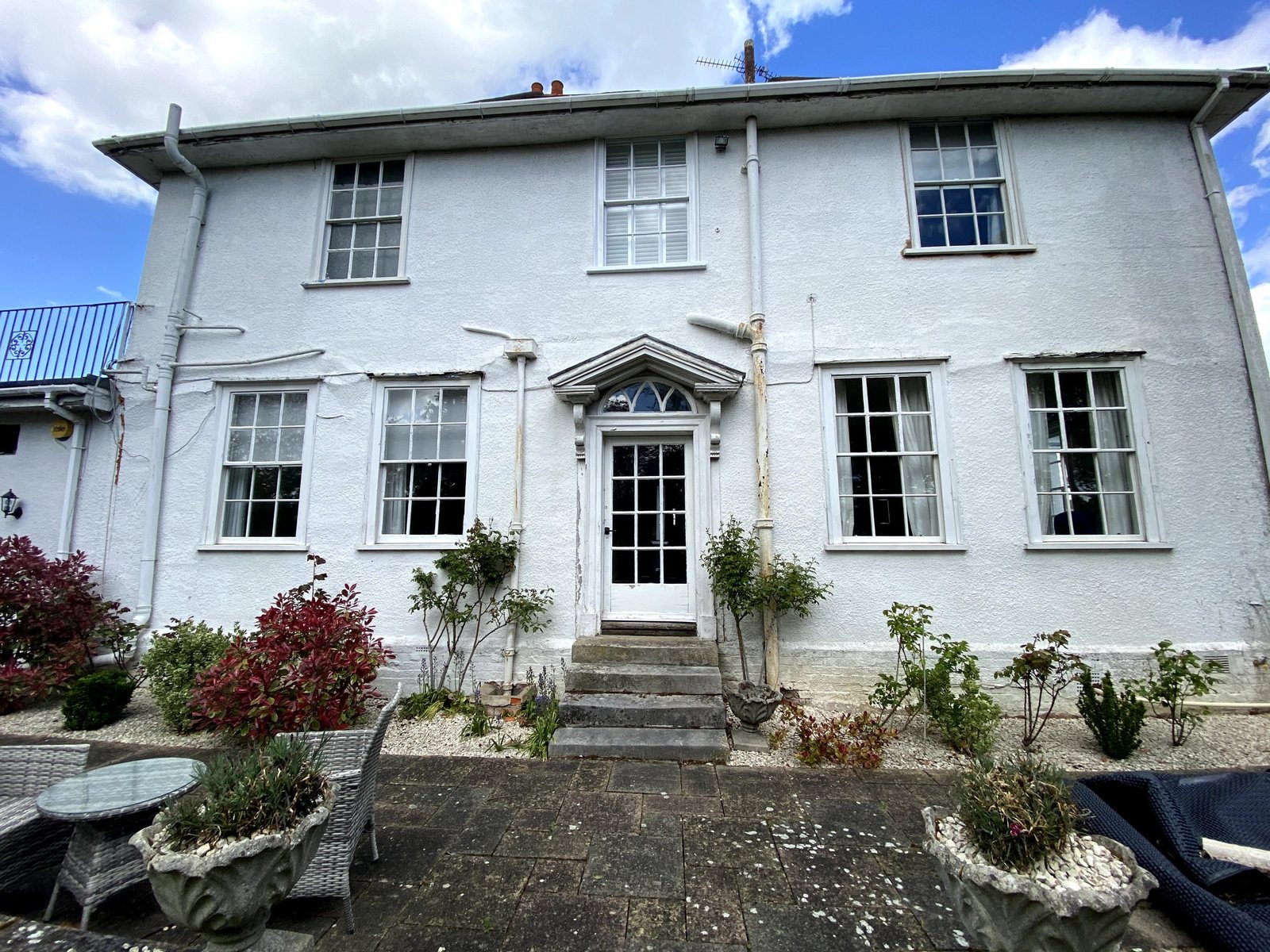
A Georgian sash near Cambridge after we reglazed it with FINEO: the original bars, and glass you would take for single glazing.
Can FINEO go into your existing windows?
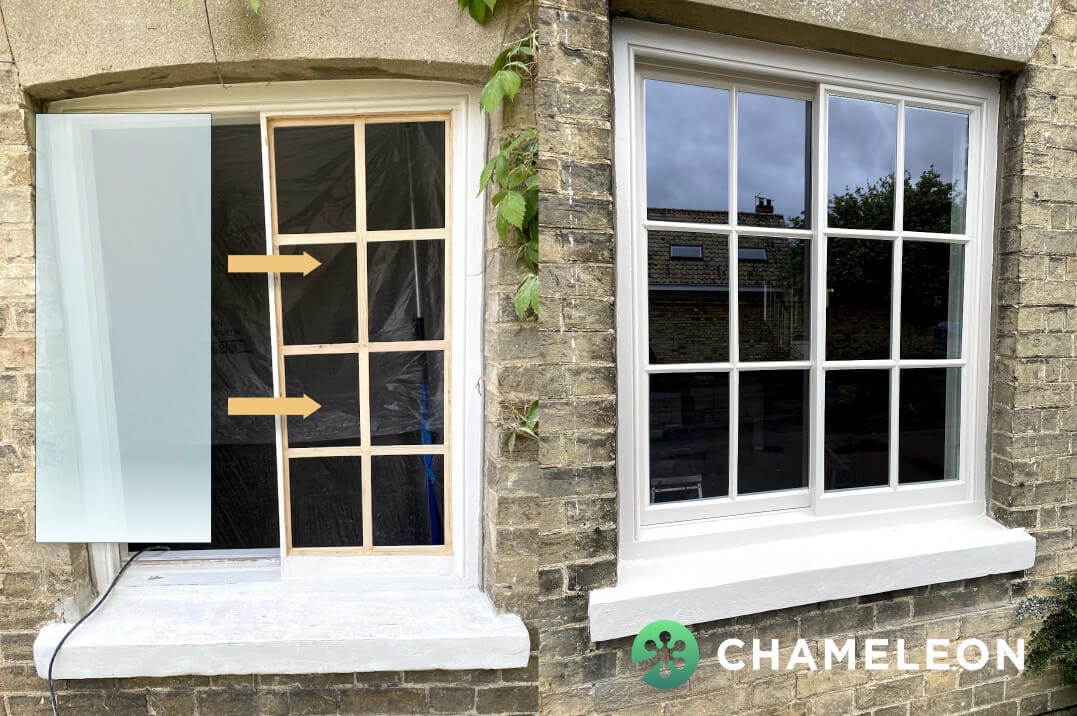
Usually, yes. An old sash was made for glass about 4 mm thick. FINEO 8 is 7.7 mm, so the rebate the glass sits in is deepened a little, and in most sashes the cut stays clear of the moulding on the inside. Regular double glazing, 24 mm or more, would cut through it. We reglaze sashes from 35 mm thick, measured from the inside face to the outside; most wooden sashes are around 40 mm.
Three more things have to be right:
- The sash must be sound. The glass is twice as heavy as single glass, so rot is cut out and new timber spliced in first, and weak corners get slim metal brackets.
- It must still slide. On a sliding sash we fit heavier weights and new cords and rebalance it.
- Safety glass where it is required. In doors and low panes, building regulations ask for toughened or laminated glass: FINEO 10, laminated FINEO or LandVac.
Listed buildings and conservation areas
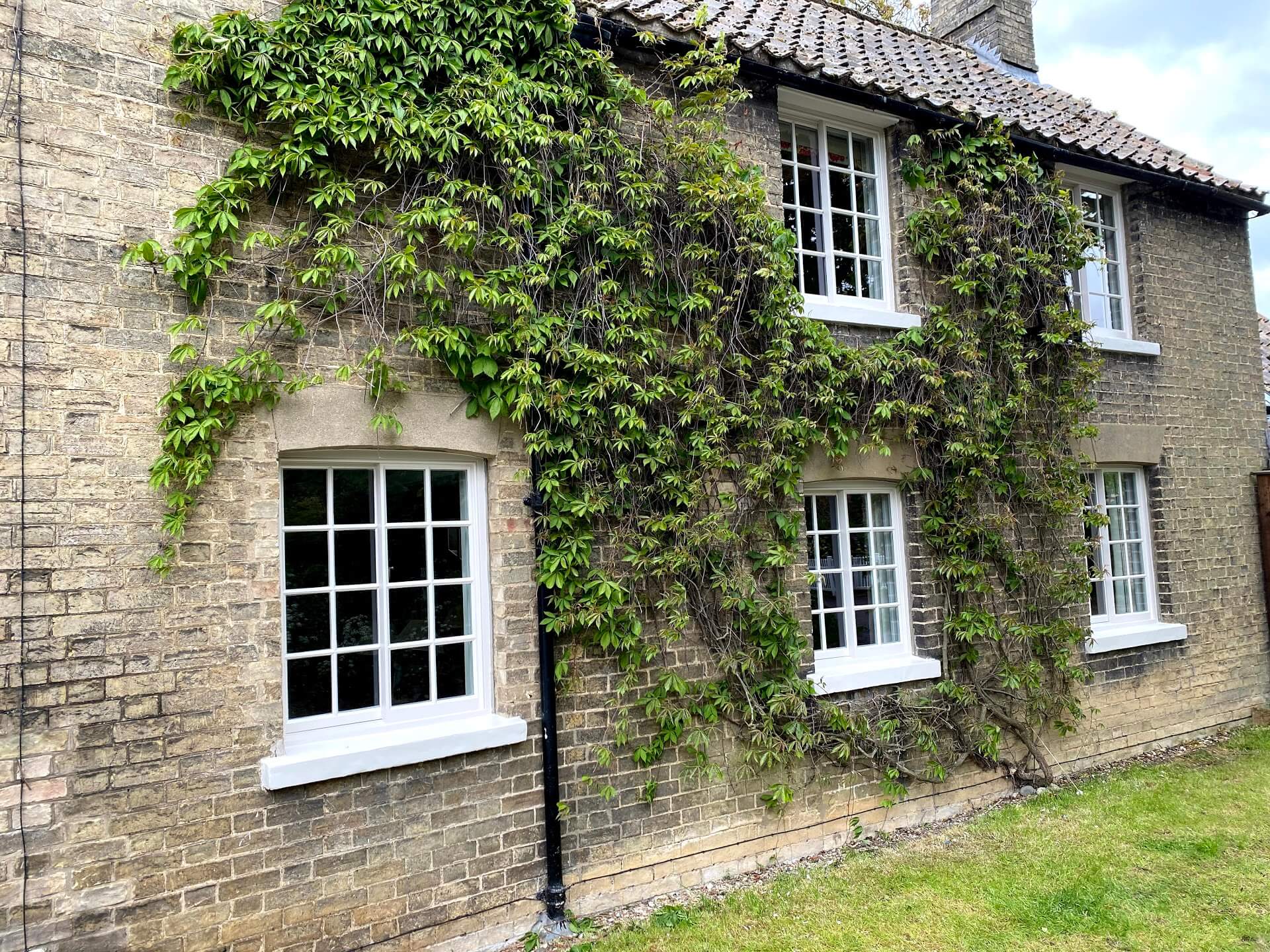
Much of the vacuum glazing we fit goes into Grade 2 listed houses, because it changes only the glass: the sashes, bars and frames stay. Historic England’s advice on windows in historic buildings treats vacuum glazing in original frames as generally acceptable, but any double glazing in a listed building still needs listed building consent, so apply before work starts. In a conservation area, check with your council. More on windows in listed buildings.
How long it takes, and how long it lasts
The glass is made to order once every pane is measured. FINEO’s distributor quotes 4–6 weeks from the factory; from accepting our quote to fitting, allow 8–16 weeks. On site, a house with 15 windows takes us 5–7 days, and any sash we take out goes back in the same day, before night.
FINEO carries a 20-year warranty from its UK distributor, which expects it to last 60 years or more: there is no gas to leak and no organic seal to wear. If a unit fails, the warranty replaces the glass, but most of the cost of a retrofit is the work, so ask your installer what their own guarantee covers.
Our FINEO and vacuum glazing jobs
Six recent jobs in original windows, from a Georgian cottage near Cambridge to an 1878 house in Chelmsford.
Swipe to see all six.
-

Georgian sash windows double glazed with FINEO
A cottage near Cambridge with sideways-sliding Georgian sashes, reglazed with FINEO, draught-proofed and redecorated.
-

Double glazing of original sash windows in Cambridge
A period home still on single glass. We took it out and fitted FINEO into the original Georgian sashes.
-

Retrofitting original sash windows in Suffolk
A Georgian house with four sizes of sash, restored and fitted with vacuum double glazing, checked with a thermal camera.
-

Double glazing retrofitting in Wing, Buckinghamshire
Sash windows, a bay, French doors and sashes set into a sloping roof, all moved from single glass to vacuum glazing.
-

Vacuum double glazing in Cambridge
Victorian sashes the owners had been told to replace. We restored them and fitted vacuum glass, starting with one trial room.
-

Double glazing in existing windows in Chelmsford
An 1878 house: paint stripped, rot cut out and new wood spliced in, then vacuum glass fitted into the original frames.
“Double glazing installation was first class, and the service Chameleon provided has been really, really good.”
Trevor and Dee, Georgian sash windows double glazed with FINEO
Frequently asked questions
Where is FINEO glass made?
In Belgium, by AGC Glass Europe, at its plant in Lodelinsart near Charleroi.
Where can I buy FINEO glass?
Through FINEO’s UK distributor and its installers. We fit it, with LandVac, into original timber windows as part of a restoration, and don’t sell the glass on its own.
What does vacuum glazing cost per m²?
For the glass alone, about £340 per m² for FINEO 8 and £390 for toughened FINEO 10 (2024 list prices, excluding VAT), with small units priced each. Fitting, joinery and VAT come on top.
Is FINEO toughened?
FINEO 8 is not; FINEO 10 is, and the glass also comes laminated. Where building regulations ask for safety glass, as in doors and low panes, a toughened or laminated unit goes in.
Is FINEO worth it?
For an old house with sound original windows, usually: it keeps the windows and their look and cuts the heat lost through the glass by about seven-eighths, for less than new timber sash windows, which start at £1,800 each in softwood.
Why is there condensation on the outside of my vacuum glass?
Because the glass is working. The outer pane no longer gets warmed by the room, so on damp mornings dew forms on it, as on a car, and clears as the day warms up.
What our customers say
More on the technology and every other vacuum glass: our guide to vacuum double glazing. On reglazing sash windows: sash window double glazing.

